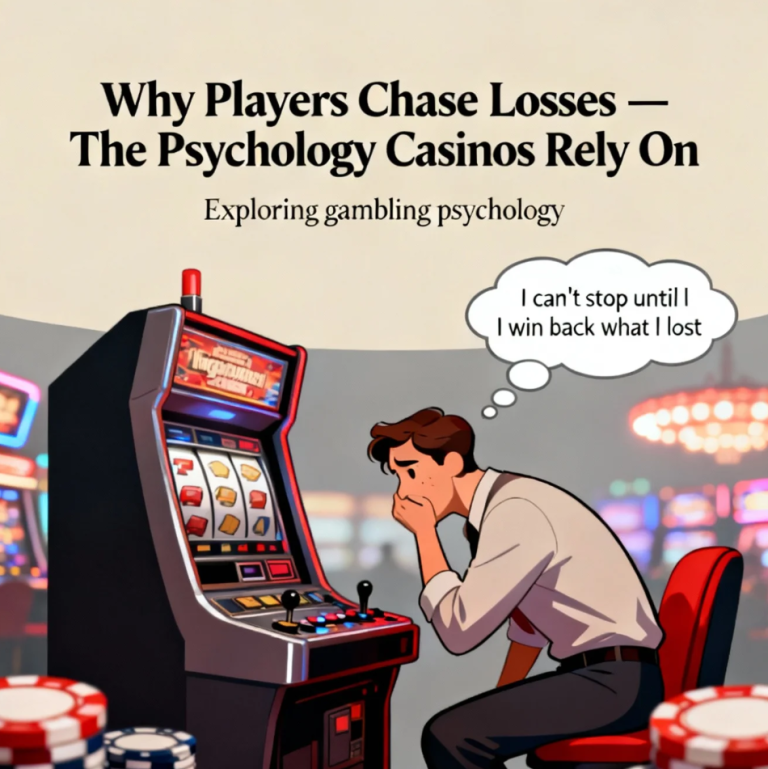
Loss chasing is one of the most well-documented behaviors in gambling psychology. It happens when players continue wagering in an attempt to recover previous losses—even when logic suggests stopping. While casinos don’t need to encourage this behavior directly, their environments are designed in ways that naturally amplify it.
Understanding why loss chasing happens is key to recognizing it—and avoiding its pitfalls.
🧠 1. The Brain’s Resistance to “Accepting Loss”
Humans are wired to avoid loss more strongly than they seek gains. This is known as loss aversion, a core principle in behavioral psychology.
When a loss occurs:
- The brain interprets it as unfinished business
- Emotional discomfort pushes the desire to “fix” the outcome
- Continuing feels better than stopping—even if it’s irrational
This instinct is powerful and largely subconscious.
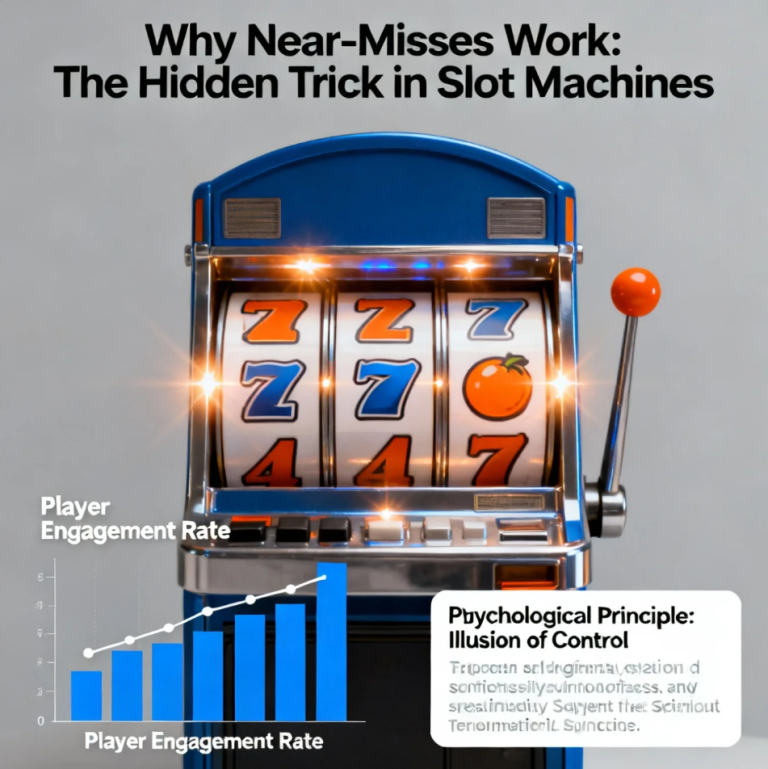
🎯 2. The “Near-Miss” Effect
Casinos rely heavily on near-miss outcomes:
- Slot reels stopping just short of a win
- Cards that almost complete a strong hand
- Bonus features that feel just out of reach
Near-misses activate the same brain regions as wins, convincing players they were close—and that the next attempt might be different.
⏳ 3. Time Distortion and Emotional Momentum
Casino environments are designed to reduce awareness of time and consequence:
- No clocks or windows
- Continuous sound, motion, and feedback
- Rapid gameplay loops that prevent reflection
When time feels blurred, decisions become emotional instead of rational, making loss chasing more likely.
🔁 4. The Sunk Cost Fallacy
Another key factor is the sunk cost fallacy—the belief that past investments justify continued action.
Players think:
- “I’ve already put so much in”
- “Stopping now makes the loss real”
- “One win could undo everything”
In reality, previous losses don’t improve future odds—but the brain struggles to let go.
🎰 5. Why Casinos Benefit Without Direct Pressure
Casinos don’t need to push players to chase losses. Their systems naturally support it through:
- Fast game cycles
- Reward animations and sounds
- Small, frequent wins that feel like progress
These elements maintain engagement while allowing psychological biases to do the rest.
🛑 6. Awareness Is the Real Advantage
Understanding loss chasing doesn’t make someone weak—it makes them informed.
Recognizing the signs:
- Playing longer than planned
- Increasing bets after losses
- Focusing on “getting back to even”
Awareness is the most effective way to regain control and make intentional decisions.
🔮 Final Thoughts: Psychology Over Luck
Loss chasing isn’t about poor discipline—it’s about human psychology responding to uncertainty, emotion, and design. Casinos rely on these predictable patterns, not because players are careless, but because the brain is wired that way.
Understanding why players chase losses turns a hidden psychological trap into something visible—and visibility is the first step toward smarter choices.
About the Author